Showing posts with label Environment. Show all posts

2012-02-14

Washington DC Travel - Bikeshare Program Helps Tourists and Residents

 Washington DC local government started a bicycle share program in September 2010. There are now 134 bikeshare stations with 1,100 bicycles in the nation's capital and the nearby city of Arlington, Virginia. The bikeshare program in Washington DC offers a wide variety of membership options including a one day, three days, a month, or a full year. Annual bikeshare memberships keep increasing beacause of the convenience and fair pricing many residents are finding with program. There are about 20,000 annual members who can walk up take a bike out. Also, about 90,000 visitors including tourists have used the Washington DC area bikeshare system.

"This is one of the many Bikeshare locations in southeast Washington. Renting a bike is as easy as 1.2.3. All you have to do is put in your credit card. Once the card is accepted, select the type of membership. The system will print your receipt and a code to unlock the bicycle. Enter that code in this digital lock, the light turns green and you are ready to roll."

Washington DC Bikeshare - Ad Free Video from VOA


Washington DC Travel Tips- Bike Rental Program Helps Tourists and Residents
Click on the below EasternShoreMag.com link to learn more about:
Washington DC Bikeshare

2012-02-13

North American Birds Shifting Winter Ranges Farther North

 Bird count data shows North American birds are shifting their winter ranges farther north. Watch this ad free video by VOA to see how thousands of birdwatchers in the United States, Canada and Latin America were out in force from mid-December to the beginning of January taking part in the 112th Christmas Bird Count. The bird count event is sponsored by the National Audubon Society, a U.S. based bird conservation organization. See how rising temperatures due to climate change could effect the Eastern Shore's wildlife including the famous Canada Geese.


Follow the EasternShoreMag.com link to more information about:
Canada Geese on the Eastern Shore

2012-01-26

Chesapeake Bay - Forests are critical to improving the water quality of the Bay

Streamside forests critical to wildlife, water quality
Bay Naturalist / By Kathy Reshetiloff - Bay Journal

When European colonists first arrived in the Chesapeake Bay region, an estimated 90-95 percent of the watershed was forested. Or put another way, forests lined both sides of almost every stream, creek and river draining into the Chesapeake Bay.

Because of their fertile soil, many riparian forests were cleared for agriculture. As more people moved into the region, more land was cleared to make room for suburban and urban developments. Today, only about 58 percent of the watershed is forested. A little more than half of all waterways in the watershed still have riparian forests of 100 feet or more bordering them on both sides.

These streamside wooded areas are critical to improving the water quality of local waterways and the Chesapeake Bay. As a transition area between aquatic and terrestrial environments, riparian forests act as buffers, intercepting rainwater and runoff that can contain pollutants such as sediment, nutrients and chemicals. Rain infiltration rates are 10-15 percent higher in forests than turf grass fields and 40 percent higher than plowed fields.

2012-01-24

Aquaponics Could Signal Future of Food - fish farming and soil-less plant cultivation in a sustainable closed system

Aquaponics Could Signal Future of Food
Technique combines fish farming, soil-less plants
VOA - Faiza Elmasry

Hydroponic gardener and author Sylvia Bernstein discovered she could use the waste water from fish to grow organic vegetables and fruits.

Imagine growing vegetables and fish in the same space. That’s the idea behind aquaponics, a marriage of fish farming and soil-less plant cultivation in a single, sustainable closed system.

Supporters believe aquaponics can play a key role in alleviating food insecurity, addressing the problems of climate change, ground water pollution and overfishing.

Recirculating wetlands system

Aquaponics is really as old as nature itself.

“Aquaponics is really a recirculating wetlands system, so it’s happening right on the banks of our lakes," says Sylvia Bernstein.

Bernstein was a hydroponic gardener for years - growing plants without soil using a water-soluble chemical fertilizer - before discovering she could use the waste water from fish to grow organic vegetables and fruits.

“Honestly, I was very skeptical and just couldn’t believe that something as simple as fish waste could become a complete fertilizer," she recalls. "So I had to actually see a system that was in a friend’s basement. But when I did, it changed my life.”

That was three years ago. Bernstein built her first aquaponics system with her 15-year-old son on a concrete pad outside her home in Boulder, Colorado. In her greenhouse today, she mainly raises tilapia and trout - feeding them once a day.

There are no weeds in her aquaponics garden, and she doesn’t have to worry about watering. The plants are growing in containers at a table height for easy access.

“I, just this morning, pulled four radishes and some lettuce for lunch," Bernstein says. "In my greenhouse right now, I grow all sorts of herbs, tomatoes, peppers.”

2012-01-23

Well Done Helps Combat Global Water Crisis


January 23, 2012

Using Ingenuity to Combat Global Water Crisis

The United Nations says there is enough fresh water for everyone on earth.  Yet nearly 1.6 billion people still face water shortages, due to inadequate infrastructure, uneven distribution and wasteful practices.  There’s an organization in California, called Well Done, that is working to lessen this global water crisis, by implementing new approaches to an old problem.

Much of the work goes on in Well Done’s headquarters building south of San Francisco.  Designers work to create compelling logos and user-friendly web layouts to spread the word on global water shortages. The goal: to help thousands of families gain access to clean water. Josh To is co-founder and head of development at Well Done, ”A lot of times people say you need education, you need sanitation infrastructure, roads schools, but without access to clean water like how can you do any of the other things?” To questioned.

Experts say having clean water can lead to greater economic and educational opportunities particularly for women who take on most of the burden of fetching water from distant sources.   Well Done promotes well-building in Sub-Saharan Africa and South Asia. The non-profit organization serves as a conduit -- raising awareness and money, then channeling the proceeds to water development organizations that do the actual work.

”We're addressing sort of two facets of the water crisis Gross overuse here at home and then non-availability in the developing world,” Jim Yoon said. Yoon is head of projects.

To spotlight high water consumption in the United States, the group created a program called Water for Water, in which intense water consumers agree to reduce their water usage and send their water bill savings to Well Done's clean-water projects.

Using interactive technology, Well Done also plans to implement a new web platform called Future Building.  It will allow donors to purchase and donate specific hardware
for well-building. To reduce overall costs, Well Done and its partner organizations require villagers who benefit to do most of the manual labor.  

”We don’t want to be that Western organization that shows up, saves the day takes the credit and then heads back and shares a wonderful story," To said. "We’re just sharing what we have with them.”

To and Yoon first met in college.  After graduating, they served in a church mission to Ghana, where they saw children swallowing malaria pills with filthy water.  

”Here we were trying to in some way alleviate their suffering," Yoon explained. "Yet the very water they’re using to take down this medicine is probably making them sick in the first place.”

Inspired by their experience in Africa, the pair drew on support from friends and family to create Well Done in 2010.  So far, Well Done has completed more than 75 clean water projects that have benefited more than 10,000 people. And To and Yoon have set their goals even higher, hoping to complete 300 water projects in the year ahead.  

2011-12-16

Learning How to Forage for Wild Edibles

Foragers Sample Nature's Bounty
Wilderness students separate the delicious from the deadly
December 16, 2011 VOA - Susan Logue | Somerville, Virginia


Today, most Americans get their food from the supermarket, but some are even going beyond farmers’ markets or backyard gardens for fresh produce. They're learning how to forage for wild edibles.

Earth Connection, about 85 kilometers south west of Washington, DC, helps foragers learn to identify what is safe to eat and what is not.

Into the wilderness

On a chilly autumn day, founder Tim MacWelch brushes aside some fallen leaves and exposes a small green plant with heart-shaped leaves and tiny pods.
He plucks a pod, pops it in his mouth, and gives his approval. “They’re juicy, they’re sour. They’re really good.”

The tasty plant is called wood sorrel. MacWelch doesn’t recommend plucking weeds from your yard and eating them until you’ve done some research. “There are plenty of bad plants out there that stay on my radar.”
According to Tim MacWelch, many parts of the pine tree are edible, but the pine nuts, protected inside the pinecone, are too small on this particular tree to harvest. The needles, when steeped in hot water make a tea that is high in vitamin C.
VOA - S. Logue
According to Tim MacWelch, many parts of the pine tree are edible, but the pine nuts, protected inside the pinecone, are too small on this particular tree to harvest. The needles, when steeped in hot water make a tea that is high in vitamin C.
MacWelch, 40, has been a student of outdoor survival skills since he was a teenager and took up backpacking. “I thought if I could find everything I needed out in the woods, then I wouldn’t have to bring it with me.”

Becoming more self-sufficient

He founded Earth Connection in 1997 and runs workshops to share his expertise.

MacWelch has had as many as two dozen students in classes. Today, he has two, Tamae and Bob Heilen.

Tamae says her husband has been interested in taking classes for a long time.

He says he wanted to be more self-sufficent. “I’d like to be able to know that if there were an emergency and I couldn’t get food in the store that I would be able to find food on my own.”
The yellow fruit of the horse nettle looks like small tomatoes, but is highly poisonous. Even animals stay away from this plant.
VOA - S. Logue
The yellow fruit of the horse nettle looks like small tomatoes, but is highly poisonous. Even animals stay away from this plant.
She got interested more recently. “I started cooking wild plants like dandelions in our yard. And it tasted really good, and I decided, I want to study.”

On Earth Connection’s four-hectare property, the Heilens learn about dandelions and other edible plants, like yarrow, which looks a little like a fern, but smells and tastes like a culinary herb. It also has medicinal properties, says MacWelch. “It is a styptic, which stops blood flow. It is also anti-bacterial.”

Wild carrots are also on the tasting menu for the day, but MacWelch cautions his students, they can be tricky to identify. Carrot roots should smell and look like smaller, white versions of the carrots found in stores.

And they should have tiny hairs on the stems. “If there are no hairs, and it smells bad," he warns, "you are looking at a poison hemlock or a fool’s parsley, both of which are deadly.”

Wild edibles

MacWelch offers his class on wild edibles every season, but says autumn is the best time to forage. “The salad greens that are out there are very mild and tender and sweet,” he says. “Tree nuts are abundant. There are still some berries and even some fruits in the end of the season.”
Rose hips are sweet and high in vitamin C.
VOA - S. Logue
Rose hips are sweet and high in vitamin C.
Even with fruits and berries, he cautions, you have to be careful. “About half of the red berries are edible to a human,” he notes.

The tiny red rosehips he plucks from a bush are an excellent source of vitamin C and, as Tamae discovers, sweet. “Those are really good. I’ve seen it so many times, but I’ve never really thought that it was edible.”

MacWelch says some students take his class on wild edibles because they are searching for new flavors. “There is stuff out here that is rare, that is not easily transported, stuff that is just off the radar of normal food consumption in America.”

And stuff that may very well be growing in many Americans’ own back yards. It just requires a bit of searching. “You’re on this mission to find this thing and you’re not sure where it is,” MacWelch says, “but you know it is out there and you know it is going to be good if you get it.”

Tim MacWelch offers a variety of wilderness survival classes throughout the year at Earth Connection. He also blogs about survival skills for Outdoor Life.

2011-12-01

Soda Bottle Solar Bulbs Bring Light to Thousands - bulbs are made out of a soda bottle, purified water and some bleach.

November 30, 2011

Soda Bottle Solar Bulbs Bring Light to Thousands in the Philippines

Sheila Royeras admires the soda bottle solar bulbs that were installed in her shanty home. The bulbs are made out of a soda bottle, purified water and some bleach. San Juan City, Metropolitan Manila, Philippines,  November 18, 2011.
Photo: VOA - S. Orendain
Sheila Royeras admires the soda bottle solar bulbs that were installed in her shanty home. The bulbs are made out of a soda bottle, purified water and some bleach. San Juan City, Metropolitan Manila, Philippines, November 18, 2011.
Thousands of small houses in low-income areas of the Philippines’ capital region are receiving ultra cheap, energy-efficient light bulbs this week. The installations are part of a broader push to install the bulbs made from plastic soda bottles in one million homes by 2012.

Sheila Royeras says she, her husband, her mother and two children spend much of their time in the dark - even during they day. Their tiny house sits less than a meter from a two-story building under construction and among close, cramped units. Natural light comes in only through the small front door. They cannot afford to use electric lights during the day.

On a recent morning, volunteer workers outfitted Royeras’ house with solar light bulbs made out of used plastic soda bottles, some purified water and bleach.

The workers cut a circle exactly the size of the bottle’s diameter into the corrugated metal roof. The one liter bottle, filled with water and two caps-full of bleach- to keep it clean and clear- is placed inside the hole, with half of the bottle poking through the roof to the inside of the house. The bottle stays in place with sealant - to keep rain out - and a small metal brace that is hammered into the roof. The liquid inside refracts sunlight and disperses about 55-watts of light into the house below. The bulbs have a five-year life.

At the end of the installation, the 15-to-20 square meter house is illuminated by three solar bulbs. Speaking in Tagalog, Royeras says having the free lights will bring a lot in savings.

Royeras says she is much happier because she expects the next electric bill to be quite a bit lower. She laughs and says she will be able to buy food for her family.

Illac Diaz, who heads the non-profit MyShelter Foundation, which is heading up this project, says in the tropics poor people live in cramped, darkened areas sealed off from rain and the searing sun. Diaz says residents should opt for this kind of bulb, instead of relying on candles or other potential fire hazards.

“It’s safer. It’s healthier," says Diaz. "It’s brighter and the funny thing is the light bulb actually comes from the place you’d least expect it, which is the trash bin. So it’s the cheapest light bulb in the world.”

Government officials say the Philippines has the highest electricity rates in Asia. Diaz says this low-tech alternative to energy efficient light bulbs will save customers an average of $10 per month on their electric bills.

The light bulb project is also set up to help poor people gain employment. The foundation currently pays a small fee to scavengers who collect the bottles and assemble and install the bulbs. Diaz says some are making a business of it.

“Once we give the technology to grassroots entrepreneurs to build it," said Diaz. "There is no limit to where it goes.”

Diaz says he has helped set up offices in Mexico, Columbia and India, where other non-government agencies have started the lighting project.

2011-11-17

Autumn Leaves - Learn about their true colors

Autumn Leaves Show Their True Colors
Mask of green hides yellow pigments

Shelley Schlender | Boulder, Colorado
VOA - November 15, 2011


As days grow shorter and nights grow cooler in Boulder, Colorado, the green leaves of summer have been putting on party colors.

On cottonwood trees and aspens, they’re golden yellow coins. On Mapleton Avenue, the maple trees are sunset shades of orange and red.

The same seasonal phenomenon occurs in many countries in late autumn, yet people don't always know the reason leaves change color when the weather gets cooler.

Fall splendor

Some do have their theories about the autumnal transformation.

“I’ve heard that the reason why the leaves change throughout the seasons is because God likes to see different colors all over the world," says one girl, "so that he can tell what season it is.”

“According to legend," says a woman, "three hunters and their dog chased the Great Bear into the sky, slaughtered it and its blood dripped onto the leaves, turning them red.”

Dave Sutherland, a naturalist with Boulder Mountain Parks, recalls the explanation he heard in childhood. “My mom told me it was because at night, when everybody’s asleep the fairies come out and paint them.”

Magical science

It turns out the scientific explanation for why leaves change color is almost as magical as artistic fairies.
The story begins in summer, when leaves are green thanks to a pigment known as chlorophyll. It captures just the right spectrum of color from the sun’s light, to power the process known as photosynthesis.

As the days grow shorter in autumn, leaves stop making chlorophyll, revealing a dazzling secret: green leaves are actually yellow.
VOA - S. Schlender
As the days grow shorter in autumn, leaves stop making chlorophyll, revealing a dazzling secret: green leaves are actually yellow.
“As the chlorophyll is grabbing that sunlight, it’s pulling water from the soil and carbon dioxide from the air and energy from the sunlight and shoving it together to make sugar,” Sutherland says.

That helps the tree blossom and grow. As the days grow shorter in autumn, leaves stop making chlorophyll, revealing a dazzling secret.

Dazzling secret

“Green leaves are yellow. You just don’t see the yellow," Sutherland says. "The yellow pigments are there all along, hidden beneath the mask of green. They’re just waiting for a chance for the chlorophyll to start breaking down so the yellow color can start shining through.”

That yellow comes from pigments known as carotinoids, which make carrots orange and autumn aspen leaves golden yellow. Some scientists say leaves keep making carotinoids after they’re done with chlorophyll, because the yellow pigments help them capture a little more solar energy.

And when they turn red? That’s another pigment called anthocyanin.

“Everybody knows anthocyanin," Sutherland says. "It makes strawberries red and blackberries black.”
And fall maple leaves red.

Natural sunscreen

But, unlike carotinoids, leaves don’t make this pigment during summer, only in autumn. For decades, scientists believed anthocyanin made a sort of accidental color, caused by sugars trapped in dying autumn leaves.

But Bill Hoch, a plant scientist at Montana State University, is among those who believe leaves make anthocyanin on purpose, as a kind of natural “sunscreen.” As an autumn leaf loses its ability to make energy from photosynthesis, he says, the red anthocyanin pigment protects the leaf from the harmful effects of sunlight - especially the blue spectrum of light.

This helps the leaf’s energy-making machinery stay intact just long enough to send the last bits of nutrients, especially nitrogen and phosphorus, into the tree’s twigs and roots.

“It’s only to recover those nutrients, because those leaves are going to be discarded pretty quickly," Hock says. "So they’re just trying to protect their photosystems long enough to just recover as many nutrients as possible.”

Hoch adds that carotinoids protect the photo systems, which are light-powered energy cells. But instead of being a sunscreen for the final days of a dying leaf, the yellow pigment is an anti-oxidant that protects the leaf throughout its life.

As for why some leaves turn yellow and others turn red, Hoch says plants that grow best in full sun tend to have more robust leaves. So, in the fall, they can get by with the protection of just the yellow carotinoids.

Plants that thrive in shade or in nutrient-poor soil tend to have more delicate photo machinery, which need more protection, so their leaves make more anthocyanins and turn dark.

There’s much more that scientists want to learn about how leaves work.  In the meantime, people in Boulder - and across the northern hemisphere - can simply enjoy the natural splendor of spectacular autumn colors.

2011-11-15

Clean Water Week - Easton, MD

CLEAN WATER WEEK 2011

November 14-18, 2011
Easton, MD
Clean Water Week is a time for friends and family to celebrate bringing back the health of local rivers and streams and the Chesapeake Bay. This week-long event features music, film, art, and the latest on efforts to stop pollution and make our local waterways clean and healthy again. People care about clean water, especially on the Eastern Shore where the health of the Bay and its rivers are so closely linked to everyday life. Whether it's swimming, fishing, boating, or just getting away from it all, being on the Shore means being near the water. Communities are charting a new course forward for reducing water pollution. Clean water plans being created now will help make our vision for healthy water become a reality. Don't miss out on this exciting opportunity to learn about what's happening for our local waterways and get involved!

Download the flier


Clean Water Week information souced from http://www.cbf.org/cleanwaterweek

MONDAY N0VEMBER 14
Clean Water Forum and Film Preview
6:00 PM (FREE)
Avalon Theatre, Easton
Learn how communities throughout the Eastern Shore are working to stop water pollution. Discover clean water's contribution to the local economy, jobs, and health and safety of our families, and get familiar with the most promising steps being taken now to protect and restore our rivers and the Bay. Join local leaders and experts for this clean water public forum hosted by the Maryland Chapter of the Sierra Club. As a special treat, a short film "Let Our Rivers Flow" will be previewed in advance of Friday's Film Festival. Refreshments will be served.
For more information and to find out how to get involved, contact Claudia Friedetzky, Maryland Chapter of the Sierra Club, at 301/277-7111 or claudia@mdsierra.org.
TUESDAY N0VEMBER 15
Children's Clean Water Poster Competition with Talbot Co. Public Schools
6:00 PM (FREE)
The Wagner Witte Gallery, Easton
Kids love clean water, and it shows when you see these fabulous artistic renderings of what a healthy environment means to them. Created in conjunction with Talbot County Public Schools, hand-made posters
created exclusively by students will be on display at one of Easton's premier art galleries. You will be amazed at what these talented young people can do! And so will the judges, who will be scoring the posters at this event in advance of an awards ceremony being held at Friday's Film Festival. Come and support clean water for the next generation. Children, bring your parents! Download competition rules
For more information, contact Jennifer Wagner, The Wagner Witte Gallery, at 443/521-4084 or jwmosaics@ymail.com.
WEDNESDAY N0VEMBER 16
Clean Water Concert: Kentavius Jones and the Poets of Unk
8:00 PM (FREE)
Avalon Theatre, Easton Join local favorites Kentavius Jones and Ryan Wilson and the Poets of Unk for a free concert to celebrate bringing back the health of local rivers and the Bay. These musicians are as passionate about the environment as they are about their music. Whether it's jazz, soul, funk, or rock, you won't be disappointed with their versatile and eclectic sounds.
For more information, contact Eddie Chen, MLCV Education Fund, at 410/440-8120 or echen@mdlcv.org.
THURSDAY N0VEMBER 17
Maryland Environmental Legislative Preview
6:00 PM (FREE)
Historical Society of Talbot Co. Auditorium, Easton
The Maryland League of Conservation Voters (MLCV) Education Fund hosts this annual Legislative Preview of environmental issues expected to be debated in the upcoming Maryland General Assembly. Each year, starting in January, state lawmakers gather for three months to find ways to improve the health and welfare of Maryland's citizens—and its environment. This program previews what Annapolis insiders are talking about. It's part of MLCV's Environmental Connections Project, helping "connect the dots" between issues people care about locally and state and national initiatives. Join legislators and representatives from local and state environmental groups for informal presentations and dialogue in a relaxed setting, and find out how to get involved in issues that matter to you! Light refreshments will be served.
For more information, contact Eddie Chen, MLCV Education Fund, at 410/440-8120 or echen@mdlcv.org.
FRIDAY N0VEMBER 18
Wild and Scenic Environmental Film Festival, Silent Auction, and Awards Ceremony
6:00 PM ($25)
Avalon Theatre, Easton
Enjoy food and drink, a silent auction, a Clean Water Awards Ceremony, and a film program lasting approximately two hours. Films include an array of professionally made wild and scenic environmental productions from 3 to 25 minutes in length, culminating in a short feature entitled "Let Our Rivers Flow." Come prepared to be thrilled and moved. Proceeds benefit the Midshore Riverkeeper Conservancy.
For more information, contact Tom Leigh, Midshore Riverkeeper Conservancy, at 443/385-0511 or tom@midshoreriverkeeper.org.

Clean Water Week is sponsored by:Adkins Arboretum
Chesapeake Bay Foundation
Choptank Tributary Team
Dorchester Citizens for Planned Growth
Easton Main Street
Maryland Chapter of the Sierra Club
Maryland League of Conservation Voters
Midshore Riverkeeper Conservancy
Talbot Preservation Alliance

For more information, contact Alan Girard, 410-924-7052 or agirard@cbf.org.

Chesapeake Bay Clean Water Week information souced from http://www.cbf.org/cleanwaterweek

2011-10-28

NASA Launches Weather Satellite

NASA Launches $1.5 Billion Weather Satellite
VOA - Friday, October 28th, 2011 at 6:30 am

NASA has launched a $1.5 billion weather satellite into orbit that aims to help improve weather forecasts and monitor long-term climate change.

The satellite, known as the National Polar-Orbiting Operational Environmental Satellite System, is being carried by a Delta II rocket 800 kilometers above the surface of the earth.

The U.S. space agency says the two-ton weather satellite, about the size of a small bus, is carrying five different types of instruments that will gather weather information to be used by national weather services across the globe.

It will also monitor other environmental data, such as ice cover and the ozone layer, that will provide scientists with better information on the effects of long-term climate change.

The satellite will enter a polar orbit, crossing both the north and south poles, which will allow it to view every part of the globe.

It will spend the next five years circling the earth about a dozen times per day.

The satellite was initially scheduled to be launched in 2006, but was delayed after scientists ran into problems with the development of several of the instruments

2011-08-18

Learn About Bats - Most bats are harmless fruit or insect-eaters.

Understanding Bats
Bat Populations Still in Decline
VOA -  Jeff Swicord


Bats are an amazingly diverse group of flying mammals that can be found in virtually every corner of the world. Because they're mostly nocturnal and a few types feed on animal blood, bats have acquired a rather dark reputation, linked in legends to witchcraft and the occult.

But most bats are harmless fruit or insect-eaters, and in North America alone, they save the farm economy billions of dollars annually by controlling destructive pests and pollinating crops.

Still, bat populations have been declining rapidly for years, due to rampant disease and human encroachment on their habitats. Our reporter introduces us to one woman in the Washington area who is working to improve public understanding of bats, and doing what she can to help them survive.

As sunlight fades from the evening sky, Leslie Sturges checks on a colony of bats she has been monitoring.

The bats gather at the portals of their summer homes - these wooden bat boxes hung on a pole in a suburban park.

One by one, the small brown bats take flight into darkness, hunting for insects and small bugs.

But Sturges says she's concerned that her count reveals only half the number of bats as last year. She hopes some have made an early return to the cave where they hibernate in winter.

“You know my hope is that a lot of the colony already moved out," said Sturges. "But I can’t be that optimistic as far as bats are concerned in the Mid-Atlantic."

Sturges is director of a conservation group called Bat World NOVA. She cares for injured and orphaned bats here in her basement. Then she releases them back to the wild.

Bat populations are declining worldwide, mostly because of habitat destruction and overuse of pesticides. Sturges says common fears that bats will fly into your hair, or that all bats carry the deadly rabies virus also contribute to human intolerance of bat populations.

“A lot of people refer to bats as filthy," she said. "But they aren’t. They groom like cats and dogs do. They use these toes back here to actually comb their fur out.”

Sturges also teaches the importance of bats at nature centers and in schools. Her goal is to promote their protection and conservation by stressing the positive things bats contribute to the environment.

“One of the things they contribute, well around here in North America, is pest control for plant-eating insects," said Sturges. "So anyone who grows anything is getting an assist from bats.”

Contrary to popular belief, bats are not blind. Their eyesight is actually pretty good. But at night they navigate in flight using a system called echo-location . They use their sensitive ears to listen for objects and bugs - that reflect back their high-pitched chirps - which we can hear with this device.

“That’s his echo-location call coming through"

Sturges and her assistant, Sherry Keen, are caring for about thirty orphaned, injured, and sick bats this summer.

And these are all this year’s orphans.

When they start to feel well enough to fly, she moves them to this screened pen in her backyard so they can develop their flight skills.

She plans to release "Shaggy", a red bat, tonight.

“He came in as an older juvenile," she said. "And he has just been able to exhibit really good flight skills and…”

Sturges wants to make sure he has a good meal before his release.

Later, as the sun sets, it's time for the bat to return to the wild.

“Bye, Shags, be good out there," said Sturges.

But “Shags” doesn’t want to leave. He would rather sleep after a big meal.

“So I think what I am going to do is put him back in and let him nap for an hour and I am going to try and release him later on tonight" said Sturges. "Because he has to go. He can’t live here.”

Sturges says "Shaggy's" chances of survival are good. Red bats are common in the area. One last bat nap in captivity and then it’s off again into the wild.


VOA - August 17, 2011

2011-08-05

How Sea Creatures Could Adapt To Changing Climate

Gray Whales (World Life Library : Nature)
Studies: How Whales, Fish Might Adapt To Warming Ocean
Gray whales might be adapting while fish populations are shifting

Tom Banse | Newport, Oregon - VOA - August 05, 2011

Two new science studies provide a glimpse of how some important Pacific Ocean sea creatures could adapt to a changing climate.

One study describes how gray whales successfully adapted to previous cycles of global warming and cooling. The second predicts a fish shift on the west coast of North America. The study suggests that some West Coast fishermen will need to pursue different prey if the Pacific Ocean warms as projected over the next 50 years.

Nick Pyenson is a paleobiologist who curates the marine fossil collection at the Smithsonian's Natural History Museum in Washington, D.C. The famous collection includes lots of creatures driven to extinction by environmental changes. It also includes some of the long fossil record for gray whales, a species that still lives in the Pacific Ocean today.

"Grey whales fit into this question about ongoing climate change," says Pyenson. He and his former doctoral advisor from UC Berkeley wondered how gray whales survived through previous cycles of global warming and cooling.

"In the past two million years, the Northern Hemisphere has undergone dramatic changes with ice sheets going all the way down to Chicago and Seattle," says Pyenson. "In doing so, that sucks up a lot of the water that would be otherwise be put in the ocean and drops sea level dramatically."

According to Pyenson, historic sea level changes periodically expanded and closed off vast feeding grounds. He theorizes gray whales hung on through bad times by either migrating less, switching food sources or both. Even today, there are small numbers of gray whales that stay in one place and eat fish and krill, while most of their species migrate long distances and bottom feed.

"What we think is telling is that those who don't migrate are telling us about the range in behavior and what these animals can do ecologically."

Pyenson says that adaptability bodes well for how the whales may respond to future climate changes. He adds one caveat though, saying the current cycle of human-induced global warming is developing faster and more powerfully than the historic episodes he examined.


Fish shift

In a separate study, a group of Canadian and American researchers examined how a warming ocean could affect fish common along the West Coast of North America.

The science team studied 28 fish species whose biology and distribution is well understood. Oceanographer Ric Brodeur of the NOAA Northwest Fisheries Science Center in Newport, Oregon, says the list includes salmon, smelt, sharks, pollock and sardines. Brodeur says the researchers simulated what could happen if the North Pacific heats up due to global warming.

"Because these fish are so mobile, they can move up and down the coast or inshore or offshore to find the preferred temperature that they want."

The federal science agency, NOAA, predicts the ocean's surface waters off Oregon and Washington will warm about two degrees Celsius over the next 50 years. Brodeur says that's enough to cause significant moves. A forthcoming research paper models how much. If you combine the home ranges of all the fish that the team studied, there's an average shift northward of roughly 40 kilometers per decade. Over time, Brodeur predicts fishermen and seafood consumers will notice.

"A lot of the species that we consider very important - like hake - things that are commercially fished here might be gone and replaced by other species that may or may not be commercially important."

Across Yaquina Bay from Brodeur's office, charter fishing boats unload sun-burned anglers. Veteran captain Robert Waddell says he's already seen some evidence of warm water species shifting northward.

“I've noticed in the last 12-13 years, we've been starting to see some marlin off and on out there and we've hooked them a few times," says Waddell.

Blue fin tuna is another possible newcomer that could fill the vacancy if, say, salmon left for cooler waters off Canada. Waddell is optimistic the local fishing fleet can adapt.

"People will make adjustments," he says. "Fifty years from now, we might be the marlin capital of the world. You never know."


How Sea Creatures Could Adapt To Changing Climate
Article from VOA

2011-07-20

Stinky Socks Attract Mosquitoes

Mosquito: The Story of Man's Deadliest Foe

Research: Bad Scent Good for Controlling Mosquitoes

Stinky socks are a hot commodity in Tanzania these days. Researchers there have discovered that the odor attracts malaria-transmitting mosquitoes at a rate four times greater than a human volunteer. The researchers are looking at ways to use the odor to trap and kill mosquitoes outdoors.

In the laboratories of the Ifakara Health Institute in Tanzania, beauty is in the nose of the beholder.

Researchers there have come up with a combination of acids, ammonia, carbon dioxide, and other components from the human body that simulate a scent repulsive to humans but delicious to malaria-transmitting mosquitoes.

And that scent is strongest on what we wear on our feet.

Dr. Fredros Okumu is principal investigator of the Ifakara Health Institute’s Outdoor Mosquito Control project.

“If you are wearing socks, the things that come off your skin can be trapped onto the sock fabric. Even if you remove the sock, you can still put this sock in a mosquito trap and the mosquitoes will still target it thinking that it is you,” Okumu said.

Dr. Okumu explains that, thanks to the widespread use of bednets, insecticides, drugs, and rapid testing kits, malaria transmission has dropped substantially in sub-Saharan Africa, by as much as 50 percent in some countries.

But, he says, a substantial amount of malaria is still being transmitted outside the home, far from bednets or other protections.

“We went out there and constructed physical devices, and these physical devices, in there we put a synthetic attractant, or we put dirty socks. We showed that we could actually kill 74 to 95 percent of all the wild mosquitoes that visited our devices,” Okumu said.

Mosquitoes lured into this trap are exposed to a chemical or fungi agent. The insects die anywhere from 24 hours to five days later depending on the agent.

To test the effectiveness of the stinky sock odor, researchers constructed experimental houses in villages in southeastern Tanzania. Male volunteers slept in some of the houses, while the synthetic stinky-foot odor was placed in other houses.

“The synthetic attractant that we made on the basis of the sock science actually proved to be four times more attractive to mosquitoes than real humans,” Okumu said.

In some cases, the mosquitoes picked the house they would fly to from up to 110 meters away.

Researchers estimate that at least 20 of the dirty-sock devices are needed to protect every 1,000 people. The devices are estimated to cost up to $27 a year including maintenance.

Dr. Okumu says the first clue that smelly socks might be attractive to mosquitoes came from an experiment in the 1990s, when a naked male researcher stood in a dark room containing mosquitoes. He mapped out where the insects bit him, which was mostly on the legs.

The project has been granted almost $800,000 in additional funding for the next two years from the Bill and Melinda Gates Foundation and a Canadian group called Grand Challenges Canada.

Researchers have several goals within the next two years: to improve previous prototypes; to estimate the reduction in malaria transmission through the use of these devices; and map out specific locations in villages where mosquitoes are most abundant.

Fellow malaria scientists have said there is potential in the research.

Dr. John Vulule is chief researcher at the Kenya Medical Research Institute. He says similar studies were conducted in the Netherlands.

“Clearly, there is something attracting mosquitoes. There is the smell of the dirty socks. People talk about the cheese-like smell in the toes,” Vulvule said.

Dr. Vulule says that what is unique about this latest research is that it connects attracting mosquitoes with killing them, acting as a form of vector control for the transmission of malaria.
 
 
Mosquito Article from VOA

US Botanic Garden Washington D.C. houses more than 10,000 plants...

Public Gets Rare View of Endangered Plants
US Botanic Garden houses more than 10,000 plants
Photographers like Josefina Mateo from California hold up the tourist traffic in the orchid room at the US Botanic Garden.
Photo: VOA - R. Skirble
Photographers like Josefina Mateo from California hold up the tourist traffic in the orchid room at the US Botanic Garden.
A plant in Namibia survives on fog. Visitors can get a rare look at the Welwitschia or Desert Onion on display at the U.S. Botanic Garden, a glass-domed building at the foot of the United States Capitol in Washington.
Opened in 1820, the U.S. Botanic Garden houses more than 10,000 plants in exhibits which reflect the world’s deserts, jungles and other landscapes. Rare and endangered species are spotlighted.

Horticulturalist Ray Mins says the lush varieties in and around rocks of an artificial lava flow and waterfall in the Hawaii room, drive that message home.

“Hawaii has one of the smallest land masses in North America, but has the largest percentage of endangered species. Almost every plant you see in this room is endangered.”

Mins points out Brighamia or “Cabbage on a Stick” whose population has been decimated in the wild due to overgrazing, development and competition from invasive plants.

Mins says the delicate balance between plant and pollinator has been upset  “The pollinator of that plant is extinct and there’s no natural way for that plant to be pollinated, although in captivity you can pollinate it.”

Jody Johnson represents Pollinator Partnership and was among two dozen exhibitors who were recently stationed at booths along garden walkways. Her group promotes the health of pollinators, critical to food and ecosystems.

She says beyond the birds, bees and butterflies are other important pollinators to watch.  “Bats, geckos, and flying squirrels being examples that people don’t know about.”

Like all flowers, orchids are dependent on pollinators. The U.S. Botanic Garden has some 5,000 species which are grown and propagaged at the garden's research center.

The way they are rotated 200 at a time into tree trunks and branches along a misty forest like walkway captivates Californian Josefina Mateo, and her family, visiting from the Philippines. “I saw this little nook in the corner with orchids from the Philippines. That got me excited.”

As his sister-in-law takes pictures, Raul de los Santos gets a closer look at an orchid he rarely sees at home.
“Having this represented helps especially for my kids to understand that there are certain things to be more aware of in the environment. We’re losing a lot of the special species that we have.”

Horticulturist Mins is troubled that so many orchids, like the ones in this display, are endangered, largely from illegal collectors.

He says the orchids help teach a lesson to passersby. “We hope that people see the beauty of native and endangered plants and can walk away understanding that actions that we take as humans and as gardeners really can affect plants and what we can do at home can help protect endangered species.”

Nancy Guyer of Clinton, Maryland comes to the garden to relax and is moved by what she sees.

“When something is gone from the world, there is no getting it back.  And everything on earth was put there for a reason, and it all affects how we live.”


US Botanic Garden
Article and Video from VOA

2011-07-19

Loss of species at the top of the food chain could have far-reaching effects on evironment -

Ocean Food Chains (Protecting Food Chains)

Loss of Predators Impacts Food Chain

Sharp decline upsets balance of the world’s ecosystems
A loss of species at the top of the food chain could have far-reaching effects on the environment, according to a study in the Journal Science.

Some of the world’s top predators - including lions, wolves and sharks - are in sharp decline. Human activities like pollution, habitat destruction, overfishing and hunting are largely to blame.

Jim Estes studies sea otters. The University of California, Santa Cruz professor of ecology and evolutionary biology says these furry marine mammals - once hunted to near extinction - are important to the health of coastal North Pacific ecosystems.

“We have discovered that sea otters have an important limiting effect on sea urchins and that allows the kelp forest to persist," he says. "And kelp forests, in turn, have all sorts of important functions.”

In the absence of sea otters, the ocean's kelp forest - which provides a habitat for fish and absorbs climate changing carbon emissions from the atmosphere - is left barren by sea urchins.
The kelp forests also provide habitat for fish and absorb climate changing carbon emissions from the atmosphere. Estes says this close connection between species health and the health of global ecosystems is a “ubiquitous phenomenon and that it occurs worldwide in all ecosystem types.”

Estes compiled the work of 24 scientists in six countries. He says the research shows the cascading ecological effects of a loss of top predators and large herbivores.

"It eventually reaches the plant populations at the base of the food web and in many instances results either in an increase in the abundance of plants or in most cases in terrestrial systems, a decrease in the abundance of plants, influencing things like fire frequency, carbon sequestration and disease and on and on and on.”

2011-07-14

Rare Earth Elements - Prices for some rising rapidly

Rare Earth Minerals: Policies and Issues (Earth Sciences in the 21st Century)Rare Earth Elements Becoming Hot Commodity

If you follow the economic news, you have probably heard that rare earth elements are a hot commodity on international markets.  China, which has a disproportionate share of the world's supply of these valuable minerals recently began restricting their export.  These minerals are important parts of many advanced electronic equipment, including batteries for electric cars.  But many people are puzzled by the term "rare earth."


Cell phones, tablet computers, video games, 3D TV sets:  Practically all advanced electronic devices - including lots of critical military hardware - contain parts made with a group of exotic minerals called "rare earths."  If you remember the Periodic Table of Elements from your high school chemistry class, rare earth refers to a group of 17 elements, also called lanthanide elements, with similar metallic characteristics, but differing from other metals.  That is exactly the reason why they are such a hot commodity.

But how rare are the rare earth elements and why are they called earths?

"Rare is a bit of a misnomer here. In some cases a better word for rare might be 'hidden,' because these rare earth elements are found, in most cases, fairly commonly in the earth's crust," noted Jeffrey Post, a research geologist at the Smithsonian's National Museum of Natural History, in Washington, DC.

Post says many rare earth elements are actually as common as tin, nickel, copper or zinc, but they tend to be widely dispersed in very small quantities.  There are only a few places where natural processes concentrated these elements enough to be mined.  So "rare," in fact, means that there's not enough of them in one place.

Nevertheless, rare earths have become a very hot commodity on the world's markets and prices for some of them are rising rapidly.  According to mineralprices.com, last December, a kilogram of yttrium cost $82 while now it costs around $200.  Dysprosium was $700 per kilogram and now it is $1,000.  Jeff Post notes that in our electronic age, many everyday devices depend on rare earth metals.

"The color images you see on LCD screens, on the computer screens… in many cases the phosphorus that produces these are based on rare earth elements," Post added.  "Many of the electronic components, the very miniature, smaller components that we need to drive these small cell phones, the small computers in a very efficient way depend on some amount of rare earth elements. The batteries, the magnets that are used in these devices, again make use of rare earth elements."

There are places on earth where natural geological processes created mineral deposits that contain large quantities of rare earth elements in crystallized form.   As the prices of rare earth metals increase it becomes profitable to mine mineral deposits that contain even small percentages of these metals.  A former iron ore deposit in China's inner Mongolia has become the world's largest mine for rare earth elements providing up to 90 percent of world's production.

Jeff Post notes that separating rare earth metals from other minerals is a complicated process. "You need to have a specialized chemical process that will separate the rare earth elements, not only from the ores but from each other.  Almost every rare earth element ore, like this one, contains not just one rare earth element but typically some amount of all the rare earth elements."

The rare earth elements are chemically very similar, so separating them from each other is a complex operation.  Geologists around the world are constantly looking for new deposits of these valuable minerals.  At the same time, the interest in recycling the elements from electronic waste is also on the rise.


Rare Earth Elements Becoming Hot Commodity
Article and video about Rare Earth Elements from VOA
Rare Earth Minerals: Chemistry, Origin and Ore Deposits (The Mineralogical Society Series)

2011-07-06

Yellowstone River Oil Spill Raises Concerns For Pipeline Safety

Oil Spills (Our Environment Series)Yellowstone River Spill Raises Pipeline Safety Concerns

Environmentalists are pushing for tighter regulations after the rupture of an Exxon Mobil oil pipeline which runs beneath the Yellowstone River in Montana.

Before it was shut off, the burst pipe spilled as much as 1,000 barrels of crude oil - more than 160,000 liters- into the river, just downstream from famed Yellowstone National Park.

High-water conditions on the Yellowstone River make damage assessments risky, according to Claire Hassett, spokesperson for Exxon Mobil. “What we have learned so far has been hindered by the rapid flow of the river right now. It’s at historic water levels. It’s very turbulent.”

The river is at flood stage, overflowing riverbanks and moving fast, carrying oil as much as 24 kilometers downstream into marshes, fields and yards.
According to Hassett, local officials were so concerned about the heavy rains and rising waters, that they ordered a temporary shutdown to inspect the 20-year old pipe in May. The pipe is buried just below the Yellowstone riverbed.

“And we did that," she says. "We conducted the same assessment that we conduct on all pipelines within our operation and we determined that it was safe to operate and again we don’t know what caused this leak so it would be premature to say the two are related.”

The accident comes at a time of rising concern over oil and gas-pipeline safety across the United States. 

2011-07-01

Urban Farm Flourishes in Silver Spring, Maryland

Urban Farm Flourishes in Downtown Area
Ninety-year-old keeps farming as development springs up around him

For 30 years,  Charlie Koiner, 90, has continued to farm, even as development has sprung up around him.
Photo: VOA - J. Soh
For 30 years, Charlie Koiner, 90, has continued to farm, even as development springs up around him.
On a warm day, Charlie Koiner tends to the fruits and vegetables growing on his patchwork farm, which is made up of a collection of small plots. A few blocks - and a world - away is downtown Silver Spring, Maryland, an urban area just outside Washington, D.C.

Koiner, 90, has grown a wide variety of produce on the lot next to his home since he bought the land 30 years ago. He calls it the best investment he ever made, but not in terms of money.

“I have an acre (4,000 square meters) of ground here and that gives me plenty of room and plenty of ground to work," he says. "So it keeps me busy just raising all this stuff. I enjoy it.”

Born and raised on a family farm that is now a shopping mall in a fast-growing Washington suburb, Koiner has gardened all his life.

"That was my grandfather’s place, and we had some 30 acres (12 hectares) right there, that was all country and everything.  And we had horses and cows and chickens and always raised a big garden.”

He takes pride in what he grows in his plots and customers drop by frequently to pick up produce. Many of them are regulars, like Martha Grundmann, who came across Koiner's farm by chance seven years ago.

2011-06-27

Salisbury University Students Kayak the Chesapeake in Experiential Learning Class

SU Students Kayak the Chesapeake in Experiential Learning Class

Friday, June 24, 2011

SALISBURY, MD---No computers. No iPods. No cell phones. No television. How does a Salisbury University student survive?

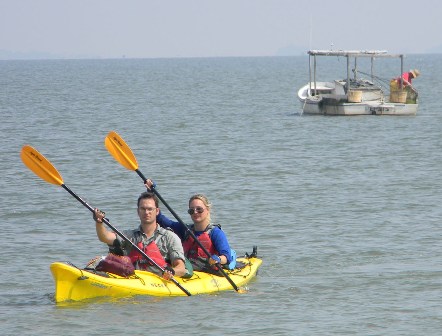
Quite well, actually, according to the participants of SU’s recent “Exploring Delmarva: A Water’s-Eye View,” a first-of-its-kind experiential learning class offered as part of the University’s Environmental Studies Program.

Co-founded by faculty members Tom Horton and Bill Nelson, the five-week class included a month-long kayak tour of the Chesapeake Bay. During the course, students often camped in the wilderness of the Delmarva Peninsula and spent their days meeting area watermen, wildlife authorities and conservation experts who explained how the bay contributes to their livelihoods, as well as the overall ecosystem—nearly 50 conversations in all.
“I don’t think we missed a single corner of the Delmarva Peninsula, from the Chesapeake and Delaware Canal to the Chesapeake Bay Bridge-Tunnel,” said Horton.

The idea came about as he recounted circumnavigating the waterway in celebration of his 60th birthday. He and Nelson worked to condense the month-long trip into a “best of the Chesapeake” tour that students could complete in 20 days, taking breaks only to go home on weekends.

“We were talking about how we would like more truly experiential programs for environmental science students,” said Nelson.

Students said the class more than met that goal.

 “It was definitely hands-on,” said Sarah Mattingly, a senior environmental science major from Annapolis. “We packed the kayaks. We cooked. We camped out.” And perhaps most importantly, the organizers “wanted our input. They wanted to know how to make this even better in the future.”

From planting eel grass in Virginia with the Nature Conservancy as part of the largest restoration project of its kind to learning about old growth forests from author and SU professor Dr. Joan Maloof to discussing environmental policy with former Congressman Wayne Gilchrest, the class offered many unique opportunities.

Students met members of the Nanticoke Native American tribe, visited watermen and trappers on Smith and Tangier islands, and learned about marine life at the University of Maryland Center for Environmental Science’s Horn Point Laboratory, a National Oceanic and Atmospheric Administration laboratory and at the Virginia Institute of Marine Science.

They also camped out among wild ponies at Assateague Island National Seashore, spent time at Cape Henlopen State Park and visited the remains of the rapidly disappearing Holland Island, as well as the Virginia barrier islands. SU faculty and administration, including Dr. Michael Lewis, director of the Environmental Studies Program, and Dr. Maarten Pereboom, dean of the Charles R. and Martha N. Fulton School of Liberal Arts, joined them for portions of the class.

“It was almost like a study abroad experience,” said Alison Mattingly, a senior environmental studies and history major, and Sarah’s sister.

Indeed, the immersion was modeled after SU’s study abroad program. Several students said the inaugural trip was transformative.

“Before this course, I wasn’t sure what to do with my major,” said senior environmental studies major Lisa Barry of Grasonville, MD. “I wanted to see the different career paths. I never thought I would want to teach at all. Now, I think I would like to teach, even as a volunteer, especially young kids.”

Meeting the bay’s environmental and folkway experts, and working closely with Horton, an award-winning author and environmental writer with The Baltimore Sun for more than two decades, sparked a different interest in Jessica Hoffmaister, a junior communication arts major from Rockville, MD.

“The trip made me realize that I like meeting and talking to people,” she said. “I’m changing my concentration from media studies to journalism and public relations because that is what I want to do now. I want to be a reporter.”

Students wrapped up the five-week adventure by working with Dr. Andrew Sharma of the Communication Arts Department faculty to prepare presentations about what they learned during the trip. The class also inspired several senior seminar projects, which students hope to work on in the coming year.

For all the days spent lugging the 90-pound kayaks and swatting mosquitoes, the 10 participants had surprisingly few complaints. In fact, they are hoping to form a club so they and other like-minded students can further explore the environment up close.

“Nothing beats camping, and looking up and seeing the stars,” said Sarah Mattingly. “Going to sleep with the sunset, with the pelicans flying by, it almost seemed fake, like something out of a movie.”

Except it wasn’t. Instead, it was a production played out on the biggest screen of all: the outdoors.

For more information call 410-543-6030 or visit the SU Web site at http://www.salisbury.edu/.


Salisbury University Press Release

Free private well water testing workshop...

The Drinking Water Book: How to Eliminate Harmful Toxins from Your Water